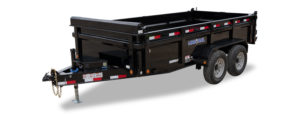

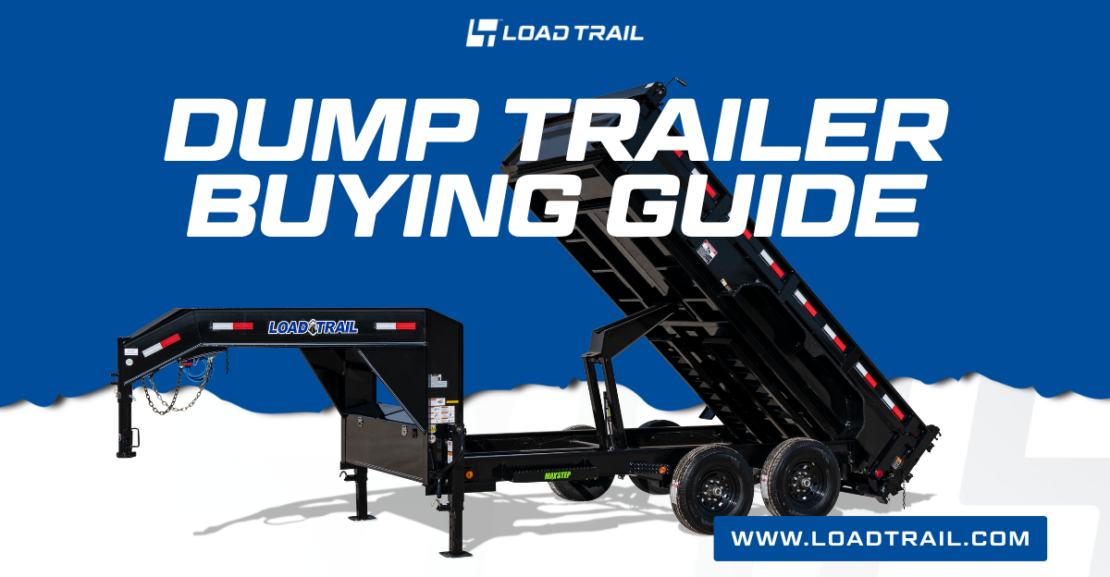
Every dump trailer looks basically the same in a parking lot: a box, a hydraulic lift, a hitch. The differences that actually matter are underneath, in the frame, the axles, and the GVWR rating, and they’re exactly what separates a trailer that handles your daily load from one that’s fighting it every trip. Load Trail builds 14 distinct dump trailer models across five GVWR classes. Here’s the full lineup, broken down by what each one is actually built to do.
Start with GVWR, not size
Gross Vehicle Weight Rating (GVWR) is the maximum total weight the trailer can handle, trailer plus cargo combined. A 14-foot dump trailer rated for 10,000 lbs and a 14-foot dump trailer rated for 20,000 lbs can look nearly identical from across a lot. The frame and axles underneath are where the real difference lives, which is exactly why model selection should start with GVWR, not box dimensions.
Entry Class
| Model | Configuration | GVWR | Axles | Frame |
|---|---|---|---|---|
| DU (DU03) | Single Axle Dump | 2,995 lbs | (1) 3,500 lb Dexter | 3/16″ Plate |
| DS | Single Axle Dump | 5,200 – 7,000 lbs | 5,200 – 7,000 lb Dexter | 6″ I-Beam |
| DT | Bumper Pull Dump | 7,000 – 14,000 lbs | (2) 3,500 – 7,000 lb Dexter | 6″ – 8″ I-Beam |
The DU is the smallest trailer in the lineup, built on a plate frame instead of I-beam construction, sized for light urban and municipal hauling rather than job-site volume. DS and DT step up from there for homeowners and light-duty contractors who need real capacity without moving into commercial territory.
Mid-range class (14,000 – 21,000 lbs)
This is the largest and most versatile class in the lineup, all sharing the same GVWR band but differing in hitch type, deck style, and frame height:
| Model | Configuration | GVWR | Axles | Frame |
|---|---|---|---|---|
| GD | Gooseneck Dump | 9,990 – 21,000 lbs | (2/3) 5,200 – 8,000 lb Dexter | 8″ I-Beam |
| GM | Gooseneck Drop-N-Go Dump | 14,000 – 21,000 lbs | (2/3) 7,000 – 8,000 lb Dexter | 8″ I-Beam |
| DM | Bumper Pull Drop-N-Go Dump | 14,000 – 21,000 lbs | (2/3) 7,000 – 8,000 lb Dexter | 8″ I-Beam |
| DL | Low-Pro Bumper Pull Dump | 14,000 – 21,000 lbs | (2/3) 7,000 – 8,000 lb Dexter | 8″ I-Beam |
| DG | Low-Pro Gooseneck Dump | 14,000 – 21,000 lbs | (2/3) 7,000 – 8,000 lb Dexter | 8″ I-Beam |
| GZ | Gooseneck Deckover Dump | 14,000 – 21,000 lbs | (2/3) 7,000 – 8,000 lb Dexter | 10″ I-Beam |
| DZ | Bumper Pull Deckover Dump | 14,000 – 21,000 lbs | (2/3) 7,000 – 8,000 lb Dexter | 10″ I-Beam |
The “Drop-N-Go” (GM/DM), “Low-Pro” (DL/DG), and “Deckover” (GZ/DZ) naming isn’t just branding, it reflects real differences in deck height and unloading style. Drop-N-Go models are built around fast, repeatable dumping cycles. Low-Pro trailers run a lower deck height for easier loading by hand or machine. Deckover models step up to a 10″ I-beam frame, adding strength for heavier, more concentrated loads within the same GVWR band.
Heavy-duty class
| Model | Configuration | GVWR | Axles | Frame |
|---|---|---|---|---|
| HG20 | Heavy-Duty Gooseneck Dump | 20,000 lbs | (2) 10,000 lb Dexter | 12″ I-Beam |
| DH20 | Heavy-Duty Bumper Pull / Pintle Dump | 20,000 lbs | (2) 10,000 lb Dexter | 12″ I-Beam |
Both HG20 and DH20 hold a flat 20,000 lb GVWR rating, no range, backed by a 12″ I-beam frame, one step up in steel from the mid-range class. This is the point in the lineup built for consistent, heavy commercial loads rather than occasional big hauls.
Tandem dual, extreme-duty class (22,000 – 30,000 lbs)
| Model | Configuration | GVWR | Axles | Frame |
|---|---|---|---|---|
| GX | Gooseneck Deckover Dump, Tandem Dual | 22,000 – 30,000 lbs | (2) 10,000 – 15,000 lb Dexter | 12″ I-Beam |
| PX | Pintle Deckover Dump, Tandem Dual | 22,000 – 30,000 lbs | (2) 10,000 – 15,000 lb Dexter | 12″ I-Beam |
GX and PX sit at the top of the dump trailer lineup. “Tandem dual” means dual wheels per axle position, not just dual axles, which is what allows these models to carry Dexter axles rated up to 15,000 lbs each on the same 12″ I-beam frame used elsewhere in the heavy-duty class. This is the class built for serious commercial volume: aggregate, demolition debris, and full-capacity daily hauling.
Reading the axle notation
You’ll notice axle specs listed as “(2/3)” on several models. That means those models are available in either a tandem (2-axle) or triple (3-axle) configuration at the same GVWR class, giving you flexibility on weight distribution and stopping power without changing trailer classes.
Gooseneck, bumper pull, or pintle
Nearly every mid-range and heavy-duty model comes in more than one hitch configuration. The pattern holds across the lineup: gooseneck for stability and higher-capacity towing, bumper pull for simpler hitching with a standard ball, and pintle for heavy commercial applications where a pintle ring adds durability and articulation under repeated heavy use.
What backs every model
Every trailer in this lineup, from the 2,995 lb DU up to the 30,000 lb GX and PX, carries the same 232 Warranty: 2-year comprehensive coverage, 3-year structural warranty, and 2-year roadside reimbursement covering both the trailer and your tow vehicle.
The bottom line
The right dump trailer isn’t the biggest one on the lot, and with 14 models across five GVWR classes, there’s rarely a reason to buy more capacity than the job calls for. Match your regular load, not your heaviest hypothetical one, to the model and frame class that actually fits, and let your Load Trail dealer help you land on the right configuration from there.
