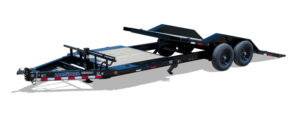

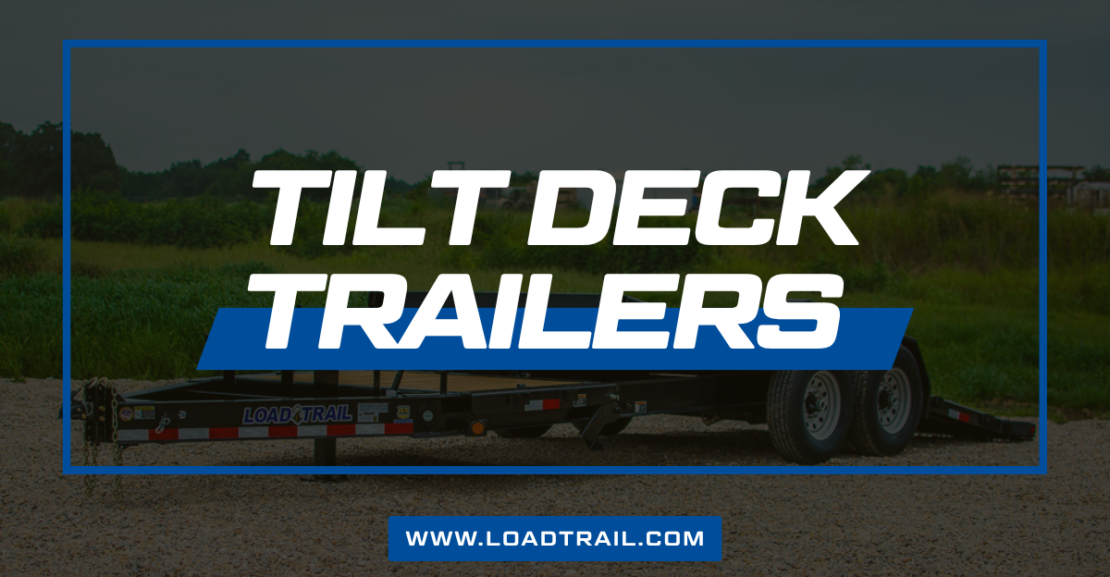
Ramps work fine until you’re loading something low-clearance, unusually wide, or heavy enough that a steep ramp angle turns into a real problem. That’s the entire reason tilt deck trailers exist: tilt the deck to the ground, drive straight on, no ramp angle to fight.
Load Trail builds tilt-deck trailers in a wide range, 7,000 up to 30,000 lbs GVWR, in single, tandem, or triple axle configurations, and in both gooseneck and bumper-pull. The real decision point is what powers the tilt.
Gravity tilt: simple, and it works
A gravity tilt trailer uses the weight of your equipment, and the trailer’s own balance point, to tip the deck down when unloaded and level out once loaded. There’s no motor, no battery, no hydraulic pump to maintain.
Good for: predictable, consistent loads where the tilt mechanism doesn’t need fine control. Fewer moving parts also means less to service down the line.
The tradeoff: less control over the tilt angle and timing. Loading and unloading can feel a little more abrupt than a powered system, and very light loads sometimes won’t tip the deck on their own.
Full-powered hydraulic tilt: control, at a cost
A full-powered hydraulic tilt trailer uses a hydraulic pump, usually battery-powered, to raise and lower the deck under direct control. You decide exactly when the deck tilts and how fast.
Good for: operators loading a wider range of equipment weights, or anyone who wants precise control over the loading process, especially with expensive or delicate equipment where a sudden gravity tilt isn’t ideal.
The tradeoff: more components (pump, battery, hydraulic lines) means more to maintain, and a higher price point than the gravity equivalent.
What actually determines the right choice
- Load consistency. If you’re hauling roughly the same weight class of equipment every time, gravity tilt is often all you need.
- Load sensitivity. Precision equipment, or anything you don’t want dropping onto the deck at gravity’s pace, points toward hydraulic.
- Maintenance appetite. Fewer parts, less to go wrong. If uptime and simplicity matter more than fine control, gravity tilt wins.
- Budget. Hydraulic systems cost more upfront. That cost buys control, not necessarily durability.
Gooseneck or bumper pull, either way
Tilt-deck trailers come in both hitch configurations, and the same logic from our gooseneck vs. bumper pull guide applies here: gooseneck for higher capacity and better stability at the top of that 30,000 lb range, bumper pull for simpler setups closer to the 7,000–15,000 lb range.
Backed the same way, every time
Whichever tilt mechanism and hitch configuration you choose, every Load Trail tilt-deck trailer carries the 232 Warranty: 2-year comprehensive coverage, 3-year structural warranty, 2-year roadside reimbursement.
Talk through your actual equipment lineup with your Load Trail dealer. The right tilt trailer comes down to what you load, how often, and how much control you want over the process, not which one looks more impressive on the lot.
